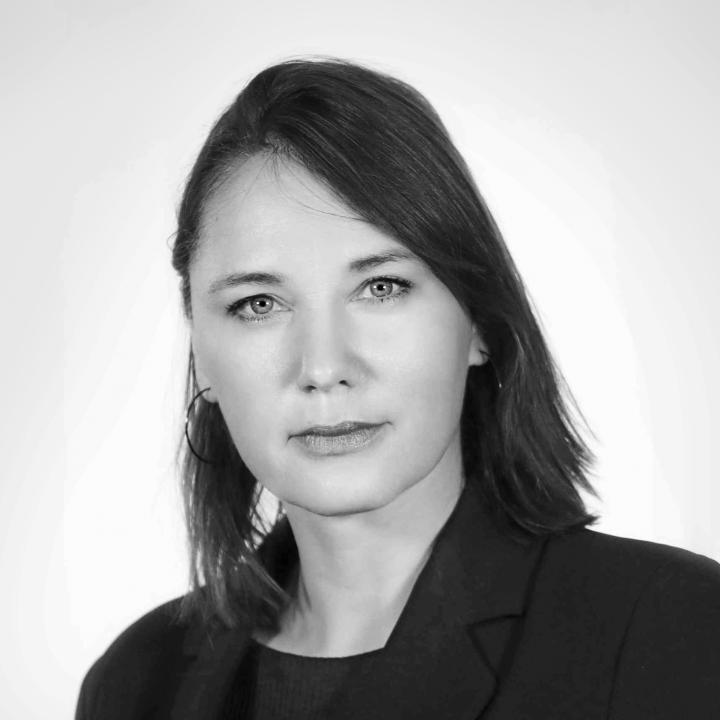
Katja Kobolt is a researcher at the Institute of Culture and Memory Studies at ZRC SAZU, where she focuses on the sociocultural and memory-related aspects of literature and art. From her undergraduate studies in comparative literature, literary history, and journalism at the University of Ljubljana, through her interdisciplinary doctoral studies in literature at Ludwig-Maximilians-Universität München, and her many years of work as a curator and art educator, Katja Kobolt focuses her research interests primarily on the democratization of literature and art, their social roles, and consequently on women’s authorship, cultural production for children, and the production, participation, and reception of literature and art by minority social groups.
Katja Kobolt is an associate professor at the Postgraduate School ZRC SAZU and teaches at the Academy of Arts at the University of Nova Gorica. She is a member of the International Research Society for Children’s Literature (IRSCL), a member of the expert working group Das Kinderliterarische Kolloquium (KLK), and a member of the editorial boards of Membrana – Journal of Photography, Theory and Visual Culture and Historijska traganja/Historical Searches.
Katja Kobolt’s research focuses on contemporary literary and artistic production and its history, particularly in the second half of the 20th century. She places special emphasis on the Slovenian cultural landscape, the regions of the former Yugoslavia, and the broader European context. Through her research questions, Katja Kobolt examines changing cultural policies and conditions of production, characteristic themes and methods, as well as modes of representation, mediation, and scholarly engagement with literature and art.
In her research, she employs interdisciplinary and comparative methods from various fields of the humanities and social sciences. She primarily combines analytical tools from the fields of literary history and theory, art history and theory, and ethnology as well as cultural anthropology. She links these with the conceptual frameworks of cultural and memory studies, particularly with the concept of social reproduction. In formulating research questions and interpreting results, she takes into account findings from the social sciences. Her research thus situates itself within feminist literary history and theory as well as art theory.
Katja Kobolt presented her research findings on the ways in which the post-Yugoslav wars (1991–1999) are addressed in women’s literature and on feminist approaches to canonization in the scholarly monograph Frauen schreiben Geschichte(n): Krieg, Gender, and Memory in the Former Yugoslavia (DravaDiskurs, 2009). She continued her exploration of the mnemonic aspects of literature and art on war and peace through original scholarly articles and chapters in academic monographs, published in journals such as International Research in Children’s Literature, Handlung, Kultur, Interpretation and by the publishers Kulturverlag Kadmos and Založba ZRC.
She has advanced feminist theory of literature and art as the author of scholarly articles and chapters and as an editor: Borec (Gender, Literature, and Cultural Memory in the Post-Yugoslav Space, 2009), Časopis za kritiko znanosti (Feminizem, umetnost, literatura, 2023), Performative Gestures, Political Moves (Red Athena UP, City of Women, 2014), No one belongs here more than you: the living archive: curating feminist knowledge (Cultural Centre of Belgrade, 2014), and in contributions to scholarly monographs published by Routledge, Maska, and Acta Universitatis Tallinnensis.
She has addressed issues of production, accessibility, and the reception of cultural production by minority communities in articles published by The Institute for Czech Literature of the CAS, Transversal Texts, and in artistic research projects such as Guestures (Balkanet, 2014), Corneous Stories (City of Women, Goethe-Institut, 2020), and n*a*i*l*s hacks*facts*fictions (District Berlin, Balkanet, 2019).
In addition, Katja Kobolt is a founding member of the Munich-based Forum for Culture, Art, and Science on/from Southeast Europe – Balkanet e.V., a member of the Association for the Promotion of Women in Culture - City of Women, both of which she also led for several years, and a founding member of the feminist curatorial collective Red Mined and the Sarajevo-based association Crvena. She has worked as a curator and art educator primarily in Slovenia and Germany, as well as in the region of the former Yugoslavia, where she has collaborated with institutions such as Humboldt-Universität, The Berlin University of the Arts (UdK), Ludwig-Maximilians-Universität München, the Goethe-Institut, the Munich Department of Culture, Lothringer13 Halle and Lothringer13 Florida, Kultur und Spielraum e.V., Münchner Kammerspiele, District Berlin, the October Salon Belgrade, and others. Katja Kobolt has joined the Institute of Culture and Memory Studies ZRC SAZU with the Marie Skłodowska-Curie or European Union – NextGenerationEU project Picturing Modernist Future: Women Illustrators and Childhood Conceptions in Socialist Yugoslavia, the research findings of which she has presented in scientific articles and chapters of academic monographs, published in journals such as Libri et liberi, Anthropos, and by the publishers Transcript and ZRC SAZU, as well as in the context of the exhibition Biba buba baja. Creating (for) the Child of Socialism (Center for Illustration, 2024). Katja Kobolt continuously presents the results of her research at international academic conferences and in the Collection of Children’s Illustrations by Female Artists in Socialist Yugoslavia (1945–1991). She is also preparing scholarly articles for the journals Časopis za kritiko znanosti and Annales, Series Historia et Sociologia, for which she will edit a thematic issue on children’s literature.
Selected publications
- “Pictures of war, pictures for peace: memory of the people's liberation struggle in Yugoslav children's literature”, Katja Kobolt, In: Petrović Todosijević, Sanja and Pogačar, Martin (ed.). Peace, unconditional!: peace policies and practices in Yugoslavia and beyond. Belgrade, Ljubljana: Institute for recent history of Serbia, ZRC publishing Institute of Culture and Memory Studies ZRC SAZU. 2025, 339-354.
- “How did artists picture the child of socialism?”. In: Messner, Elena idr. (ur.). Women and partisan art: aesthetics and practices of resistence in Yugoslavia and Carinthia. Bielefeld: transcript. 2025, 139-148.
- “The Little prince defies silence: literary and cultural agency for and with children in times of displacement”, Katja Kobolt. In: Kavšek, Blaž in Moder, Gregor (ed.). The resilience of history: the Yugoslav wars through art.Ljubljana: Maska. 2024, 161-187.
- "Confronting (post-)war precariousness and precarity: socialist Yugoslav literature for children", Katja Kobolt. International research in children's literature. 2024, 17/3, 306-320.
- “Literature builds children, children build literature: literary education in socialist Yugoslavia and children’s literary agency", Katja Kobolt. Anthropos. 2024, 56/1, 97-123.
- "Artistic work for children between productive and social reproductive work", Katja Kobolt. Libri et liberi: časopis za istraživanje dječje književnosti i kulture. 2023, 12/2, 253-274.
- “Postmigrační estetika: autofikční narativní působení v psaní Dijany Matković a vizuální tvorbĕ Anny Ehrenstein”. In: Antošíková, Lucie (ed.). Ženy v (e)migraci : posttraumatická vyprávění 20. století. Prague: Academia: Ústav pro českou literaturu AV ČR. 2025, 68-88.
- “The platform of care: collective curatorial modes of the n*a*i*l*s hacks*facts*fictions platform”, Katja Kobolt, Brigita Miloš, Petra Grafenauer. In: Krasny, Elke and Perry, Lara (ed.). Curating with care. New York: Routledge. 2023, 224-236.
- “Negotiating the impact of literature for children in early socialist Yugoslavia«, Katja Kobolt. In: Kosmos, Iva and Pogačar, Martin idr. (ed.). Social impact in arts and culture: the diverse lives of a concept. Ljubljana: ZRC SAZU, Založba ZRC. 2022, 338-359.
- “One-dimensional artist/intellectual in the heteronomy of labour”, Katja Kobolt. Maska. 2020, 35/200cc, 86-96.
- “How to speak precarious histories from a precarious position?: form(s) of knowledge: nothing is given”, Katja Kobolt. In: Buden, Boris and Dokuzović, Lina (ed.). They'll never walk alone: the life and afterlife of gastarbeiters. Dunaj: Transversal Texts. 2018, 125-143.
- “Atlantis: zu Kontext und Pragmatik postjugoslawischer Kunst“, Katja Kobolt. In: Richter, Angela and Matijević, Tijana and Kowollik, Eva (ed.). Schwimmen gegen den Strom?: Diskurse weiblicher Autorschaft im postjugoslawischen Kontext. Münster: LIT. 2018, 189-209.
- “Post-Yugoslav contemporary art practice as a generating force of emancipatory memory and politics”, Katja Kobolt. Ìñtèrkùltùràlnòst: časopis za podsticanje i afirmaciju interkulturalne komunikacije. 2016, 11, 119-128.
- »Wahlverwandschaften: Kunst und Erinnerung im Libanon und Bosnien-Herzegowina«, Katja Kobolt. In: Jakiša, Miranda and Pflistch, Andreas (ed.). Jugoslawien - Libanon: Verhandlung von Zugehörigkeit in den Künsten fragmentierter Kulturen. Berlin: Kulturverlag Kadmos, 2012, 318-333.
- »Feminist curating beyond, in, against or for the canon?«, Katja Kobolt. In: Kivimaa, Katrin (ed.). Working with feminism: curating and exhibitions in Eastern Europe. Tallinn: TLU. 2012, 40-63.
- »Art and migration: the troubled relations between the centre and the periphery«, Katja Kobolt. In: Zdravković, Lana and Jelesijević, Nenad (ed.). Living on a border: research of the European contemporary migration phenomenon: permanent waiting room: mobile art installation: Bologna, Ljubljana, Vienna, London. Ljubljana: Institute of Art Production and Research KITCH, 2008, 13-19.
- »Wie schreiben, wenn sich die Geschichte wiederholt?: das europäische literarische Erbe als Erinnerungsmodell für die postjugoslawischen Kriege«, Katja Kobolt. In: Zemanke, Evi and Krones, Susanne (ed.). Literatur der Jahrtausendwende: Themen, Schreibverfahren und Buchmarkt um 2000. Bielefeld: Transcript, 2008, 107-122.
- »Književnost sećanja Daše Drndić ili diagnostika predela sećanja na Balkanu. ProFemina: časopis za žensku književnost i kulturu. 2007/2008, 10/46/50, 142-149.
- »Krieg - Literatur(Wissenschaft) - Geschlecht: zur Kanonisierung der Literatur über die (postjugoslawischen) Kriege«, Katja Kobolt. Handlung, Kultur, Interpretation. 2007, 16/1, 44-68.
- »Smrt u muzeju moderne umjetnosti Alme Lazarevske - ili Zašto se ratna literatura ženskih autora (spisateljica) ne recipira kao književnost u ratu«, Katja Kobolt. Sarajevske sveske. 2006, 14, 296-320.
Editor of thematic issues and volumes
The Thrid Space in Socialist Yugoslav Children’s Literatures. Annales, Series Historia et Sociologia, Katja Kobolt (ed.). 2026, 36/3. in statu nascendi.
Feminizem, kuriranje in kanon. Časopis za kritiko znanosti, Katja Kobolt and Petja Grafenauer (ed.). 2023, 51/289.
Roževina zgodovine. Kozmetika v družbi in času, Katja Kobolt and Petja Grafenauer (ed.). 2020. Ljubljana: Mesto žensk.
No one belongs here more than you: the living archive: curating feminist knowledge: 54th October Salon, Jelena Petrović and Katja Kobolt et al. (ed.). Belgrade: Cultural centre of Belgrade, 2014.
Performative gestures, political moves, Katja Kobolt and Lana Zdravković (ed.). Ljubljana, Zagreb: City of Women, Red Athena UP, 2014.
Monograph
Frauen schreiben Geschichte(n): Krieg, Geschlecht und Erinnern im ehemaligen Jugoslawien, Katja Kobolt. Klagenfurt, Vienna: Drava, 2009.
- Picturing Modernist Future: Women Illustrators and Childhood Conceptions in Socialist Yugoslavia (follow up) (research project • October 1, 2024 - June 30, 2026)
- Picturing Modernist Future: Women Illustrators and Childhood Conceptions in Socialist Yugoslavia (research project • October 1, 2021 - September 30, 2024)
- University of Nova Gorica, Academy of Arts, Critical Theory of Art and Media (course co-ordinator, visiting lecturer)
- ARIS Award for Excellence in Science 2025 for the work: The resilience of history: the Yugoslav wars through art, a collection of scholarly chapters.
- member of The International Research Society for Children's Literature
- member of the academic working gropu Das Kinderliterarische Kolloquium
- member of the editorial boards Membrana – Journal of Photography, Theory and Visual Culture in Historijska traganja/Historical Searches.
- member of the Scientific board of the Institute of Culture and Memory Studies ZRC SAZU
- member of the Association of the Promotion of Women in Culture – City of Women
- member of the Forum for Culture, Art, and Science on/from Southeast Europe – Balkanet e.V.