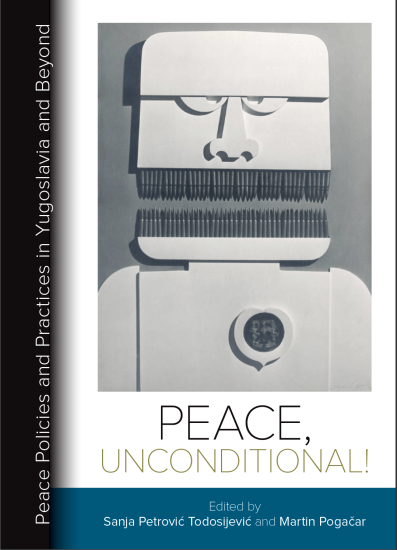
Author:
Sanja Petrović Todosijević, Martin Pogačar
Year:
2025
Today, peace is rarely discussed. It is not taken seriously. At best, it is understood as an insignificant and marginal “by-product” of political and economic processes, or indeed an obstacle to these very processes. In a culture that normalises violence and warfare – against people, animals, plants and the entire planet – and in a culture of endless exploitation of resources, both organic and inorganic, of space and time, peace has become decentralised and delegitimised. Essentially, it is portrayed as an obstacle and hindrance to “freedom, democracy and progress”. For this reason, we invite you to pause and take time to look back into the past, to unsuccessful initiatives, potentially good solutions and failed implementations. Let us be humble before the suffering and destruction that have inadvertently shaped who we are today. Peace is always conditional. The demand for the unconditional nature of peace should be understood as a key element in creating a world worth living in. This book is a contribution to the quest for such a world.
December 2025: Award from the "Pazi šta čitaš" festival (Belgrade) for scientific contribution.
-
Author
Other authors
individual contributions
Zdenka Badovinac, Stanislava Barać , Jovan Čavoški, Natalija Dimić Lompar, Petar Dragišić, Luka Filipović, Tina Filipović, Nika Grabar, Zoran Janjetović, Gal Kirn, Ana Kladnik, Peter Klepec, Katja Kobolt, Nataša Kostić, Rastko Lompar, Tomaž Mastnak, Srđan Mićić, Vladimir Petrović, Sanja Petrović Todosijević, Martin Pogačar, Luka Savčić, Nemanja Stanimirović, Svetlana Stefanović, Petra Svoljšak, Ovidiu Ţichindeleanu
-
Publishing Houses:
Institute for Recent History of Serbia (Beograd), Založba ZRC
-
Publisher
-
ISBN
978-86-7005-206-2
-
Year
2025
-
Series
Language(s)
-
Specifications
paperback 16 × 23 cm 592 pages
-
E-publications
29. 10. 2025
-
Permalink